City Terror: The Polite Edge of Street Art Typography
Capturing the Authentic Pulse of Urban Tagging
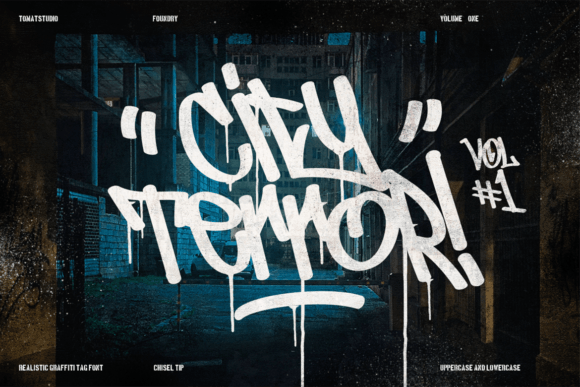
In the world of display fonts, there is often a fine line between looking "cool" and looking authentic. City Terror bridges that gap by offering a raw, gritty texture derived from actual street experience. Unlike many computer-generated typefaces that mimic graffiti, City Terror was born from a Wacom tablet, manually hand-drawn to capture the exact pressure, flow, and imperfections of a real marker on a wall. This is not just a font; it is a digitized piece of street culture. However, what sets this particular typeface apart is its temperament. While many graffiti fonts lean heavily into chaotic aggression, City Terror brings a sense of "politeness" to the table. It retains the urban edge and the rough texture of the street but presents it with a cleaner structure that makes it accessible for commercial and creative work.
The personality of City Terror is defined by its realistic ink bleed and varying line weights. It feels like a marker that has been used until the ink is running low, creating that distinct dry-brush effect that designers love. Because it includes both uppercase and lowercase letters, it offers a versatility often missing in the graffiti genre. You are not locked into shouting with all caps; you can create sentences that flow naturally, making it a viable option for more than just headers. The "polite" nature of the design means it communicates rebellion without being illegible or offensive to a mainstream audience. It is the perfect tool for when you want to inject street credibility into a design without sacrificing clarity.
Visual Characteristics and Typographic Precision
One of the most critical aspects of typography is spacing, and in the graffiti world, spacing is everything. A tag is defined by how the letters interact, how they overlap, or how tight they squeeze together. City Terror was built with this philosophy in mind. The default kerning and tracking are intentionally tight, mimicking the density of real street tagging. When you type with City Terror, the letters sit close together, creating a unified block of text that feels heavy and grounded. This tight spacing is essential for that authentic "writer" look. However, digital design often requires flexibility. To accommodate this, the font is engineered for easy manual adjustment. By using standard shortcuts like Alt/Opt + Arrow Left or Right, you can quickly adjust the kerning to loosen the text for readability or tighten it further for stylistic impact.
From a design assets perspective, the construction of the glyphs is robust. The strokes are not uniform; they taper and swell just like ink from a chisel tip marker. This creates a dynamic visual hierarchy even within a single word. When utilizing City Terror in your projects, pay attention to the font pairing. Because it has such a distinct personality, it pairs best with clean, geometric sans serif fonts or simple serif fonts. Using a complex script font alongside City Terror might result in visual clutter, whereas a minimal modern typography style will allow the graffiti element to stand out as the hero of the design.
Strategic Applications for Brand Identity and Marketing
For designers, entrepreneurs, and brand strategists, choosing the right typeface is about aligning the font’s voice with the brand’s message. City Terror excels in scenarios where a brand needs to project authenticity, urban culture, or counter-culture appeal. It is an ideal choice for logo design in the music industry, skate shops, streetwear brands, or independent record labels. The font possesses a "real" quality that resonates with audiences who value originality over corporate polish. When used in packaging design, particularly for products like craft beer, energy drinks, or artisanal goods targeting a younger demographic, City Terror can instantly communicate that the product is edgy and handcrafted.
Beyond physical products, this creative font has significant applications in digital marketing and social media graphics. In a sea of generic sans-serifs, a headline set in City Terror stops the scroll. It works exceptionally well for YouTube thumbnails, Instagram stories, and event posters. The texture of the font ensures that it remains legible even when scaled down, provided you respect the tight kerning. For editorial design, such as magazine headlines or blog post graphics, City Terror can be used to highlight quotes or pull-out text that needs to feel conversational and urgent. It moves away from the stiffness of traditional corporate typography and brings a human element to web design and digital content.
Practical Guide to Implementation and Licensing
When integrating City Terror into your workflow, it is important to treat it as a display typeface. While it is legible enough for short sentences, it is not designed for long-form body copy. Its strength lies in headers, sub-headers, and call-to-action buttons. To get the best results, evaluate the specific needs of your project. If you are creating a brand identity for a luxury law firm, City Terror is likely the wrong choice. However, if you are designing flyers for a music festival or a menu for a burger joint, it is the perfect fit.
Before finalizing your design, always test the font pairings. Try combining City Terror with a neutral sans serif font like Helvetica or Roboto for the body text. This contrast allows the graffiti font to shine without overwhelming the viewer. Review the included styles; utilizing the full range of uppercase and lowercase options will give your layout a more sophisticated rhythm. Finally, ensure you have the correct commercial font license for your specific use case, whether it is for merchandise, digital ads, or client work. By treating City Terror with the same professional respect as any other premium font, you can unlock its full potential to create designs that are both visually striking and deeply authentic.