Waiting Friends: The Slab Serif That Feels Like Home
There's a specific challenge in design: finding a typeface that feels both professional and personal. Too often, fonts lean heavily into cold minimalism or overly decorative flair, leaving a gap in the middle where warmth and reliability should live. Waiting Friends is a creative font designed to fill that exact space. It’s not just another slab serif; it’s a typeface with a handshake built into its letterforms. If your project needs to communicate trust without sounding corporate, and approachability without sacrificing structure, this is a font worth exploring.
The Anatomy of Approachability
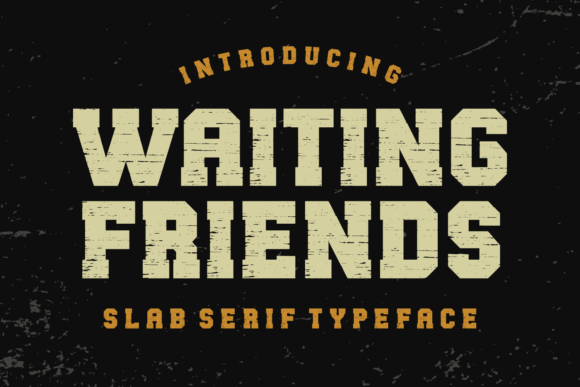
At its core, Waiting Friends is a premium font that balances sturdy construction with an inviting demeanor. The defining characteristic of a slab serif is the blocky, rectangular feet and terminals on its letters. In many classic slab serifs, like Rockwell or Clarendon, these features can feel bold and authoritative, sometimes even a bit industrial. Waiting Friends takes that structural integrity and softens it. The serifs are present and grounding, but the curves of the bowls are generous, and the overall letter shape feels rounded rather than sharp. It avoids the stark geometry of a modern sans serif while providing more personality and stability than a standard serif font like Times New Roman.
This visual personality makes it incredibly versatile. It doesn't scream for attention like a display font meant for a movie poster, nor does it disappear into the background like a standard body text workhorse. Instead, it occupies a comfortable middle ground. It suggests a brand or a message that is confident, friendly, and straightforward. Think of the difference between a bank building made entirely of glass and steel versus one with warm wood and solid, welcoming doors. Waiting Friends is the architectural equivalent of the latter.
Where This Typeface Truly Shines
Understanding the font’s personality is the first step; knowing where to deploy it is where the strategy comes in. Because of its dual nature—reliable yet warm—Waiting Friends adapts well to a surprising variety of design contexts.
Branding and Identity
For entrepreneurs and small business owners, brand identity is everything. If you are building a brand that centers on community, craftsmanship, or direct-to-consumer service, this typeface can become a cornerstone of your visual language. It works exceptionally well for:
- Logo Design: Its distinct silhouette ensures memorability without relying on trendy effects that will date quickly. A logo set in Waiting Friends feels established from day one.
- Packaging Design: On shelf, consumers scan quickly. The sturdy nature of this slab serif grabs attention, while its friendly vibe invites customers to pick up the product. It’s ideal for artisanal foods, boutique cosmetics, or children’s educational materials.
- Brand Guidelines: Using Waiting Friends consistently across business cards, letterheads, and invoices creates a cohesive brand identity that feels unified and professional.
Digital and Web Design
In the realm of web design, readability is king, but personality is queen. A common mistake is choosing a font that is legible but boring. Waiting Friends offers high legibility even at smaller sizes, making it a strong candidate for website navigation menus, subheadings, or pull quotes. When used for headlines, it draws the reader in with a sense of warmth, reducing the "bounce rate" by making the content feel less intimidating and more conversational.
For social media graphics, where the scroll is fast and competition is fierce, this font provides a visual anchor. It stands out against both photographic backgrounds and solid color blocks. Whether you are creating an Instagram story or a LinkedIn carousel, the font helps maintain a consistent voice that feels human rather than automated.
Publishing and Editorial
For bloggers and publishers, the choice of typeface influences how long readers stay on the page. Editorial design often relies on a hierarchy where the headline needs to be punchy and the body text needs to be effortless to read. While Waiting Friends is robust enough for short blocks of body text, it truly excels in headers, chapter titles, and pull quotes in magazine layouts or blog headers. It bridges the gap between a serious news story and a lifestyle feature, making it perfect for content creators who mix information with personal storytelling.
Strategic Implementation: Pairing and Hierarchy
No font is an island. To get the most out of Waiting Friends, you need to consider how it interacts with other design assets. The goal is visual contrast that creates a clear hierarchy.
A classic and effective strategy is to pair this friendly slab serif with a clean, geometric sans serif font. The simplicity of the sans serif will let the personality of Waiting Friends shine in the headlines without the two competing for attention. Alternatively, for a more eclectic, creative vibe, you might pair it with a subtle script font or handwritten font for accent text—though use this sparingly to avoid visual clutter.
When evaluating the fit for your project, consider the "voice" of your content. Is the text authoritative or advisory? If it's purely informational data, a cold sans serif might work. But if the text is persuasive, instructional, or narrative, Waiting Friends adds a layer of human connection that data alone cannot achieve. It softens the blow of a "Terms and Conditions" page and makes a "Welcome" page feel genuine.
Practical Considerations for Professionals
Before integrating any new typeface into your workflow, a few practical checks are necessary. First, always review the included styles. Does the font family come with bold and italic variations? You need these to create emphasis and hierarchy within your paragraphs. Waiting Friends maintains its legibility and character across its weights, ensuring that your bold headers don't become muddy or overly heavy.
Second, consider the licensing. If you are a freelancer or a business owner, you need to ensure you have the correct commercial font license for your specific use case—whether that is for a client’s logo, a printed book, or a mobile app. A premium font like this is an investment in your brand's perceived value, but it must be used legally.
Finally, test for readability on multiple devices. A font that looks charming on a high-resolution desktop monitor might lose some nuance on a small mobile screen. However, the sturdy construction of Waiting Friends generally holds up well in digital environments, provided you maintain appropriate line height and contrast.
In the crowded landscape of modern typography, Waiting Friends